SPOTTED CATBIRD
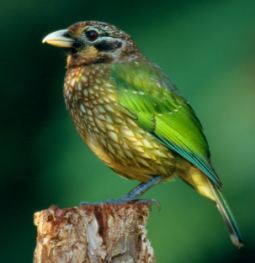
Photo: Courtesy of Jonathan Munro
Wild Watch Australia guiding service

ENDEMIC Tropical North QLD SPOTTED CATBIRD: Ailuroedus melanotis 28 cm Some say it's a bowerbird, and some argue its a closely related species. Unlike a Bowerbird it is not polygamous and does not construct a bower or display court. It is found from near Townsville to Cape York, in New Guinea and several adjacent islands, preferably at mid to higher altitudes. Breeding adults generally live in permanent territories. Spotted Catbirds are numerous round Chambers Wildlife Rainforest Lodge, where they often perch on balconies or window ledges.
Identifying Characteristics: A green bird with scale like spots adorning their underpart The Spotted Catbird strongly resembles the Green Catbird in its colour pattern, but is more boldly marked. Some believe the two birds to be the same species, and therefore they are sometimes grouped in this way. However, they do have several other differences. The male and the female are both 26-30cm and look identical to each other.
Distribution: Call: These birds are so named for their distinctive, cat-like call (like meowing). The distinctive wailing call is uttered mostly at dawn and dusk.
Breeding: The Spotted Catbirds live in pairs, and unlike bowerbirds, they maintain their pair bonds year after year. The birds raise their young together. They make a bowl-shaped nest of sticks and leaves about 2-10m above the ground. Usually one or two plain cream coloured eggs are laid, but sometimes three. The breeding season is from September to December. Incubation is 19-25 days, and nestlings fledge at about 18-22 days. They may become independent of their parents at 60-80 days after fledging.
Diet: They feed on fruit (mainly figs), buds, shoots, seeds, flowers, insects and other birds’ eggs and young. It is common for the parents to tear apart these young birds to feed to their own offspring.
Additional Information: Courtesy of Damon Ramsey Their calls include the distinctive “chee-ahh”, only vaguely cat-like, and other sounds, like a 'mechanical sneeze', and various clicks. They are found in the tropical rainforests of Cape York, Australia.
Script: Courtesy of Damon Ramsey BSc.(Zool) Biologist Guide
RETURN TO BIRD INDEX
|

