SCARLET HONEYEATER
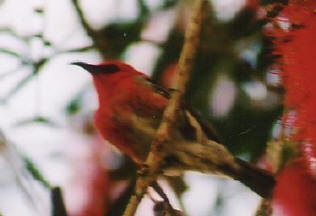
Photo: Courtesy of Damon Ramsey
BSc.(Zool) Biologist Guide

SCARLET HONEYEATER
Myzomela sanguinolenta 11 cm
Despite its brilliant colour, the male Scarlet Honeyeater is often difficult to observe because it is small and forages mainly in tall trees. Usually the Scarlet Honeyeater occurs in flocks following the seasonal flowerings of plants. These birds are observed most readily in gardens where native plants such as grevilleas and bottle-brushes predominate. It is often detected first by its sweet jingling call. Can easily be seen in Spring on the flowering Jacaranda tree at Chambers Wildlife Rainforest Lodge .
Additional Information: Courtesy of Damon Ramsey The male of this species has a bright red head and chest and black wings, whilst the female is a dull brown. They are often found near blossoms of equally bright red Banksia. They are found in rainforest, woodlands and even urban areas along the east coast of Australia, perhaps more commonly seen in the tropical part of their range. They are also found in tropical Asia and islands of the tropical Pacific.
Script: Courtesy of Damon Ramsey BSc.(Zool) Biologist Guide Additional Scarlet Honeyeater Photo RETURN TO BIRD INDEX
|

