| Chambers Wildlife Rainforest Lodges |  |
|
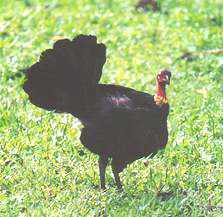
AUSTRALIAN BRUSH-TURKEY: Alectura lathami 70 cm The Australian Brush-turkey is one of three megapodes in Australia. The family name refers to the robust feet of all species. It is a large, black turkey-like bird. The head is red head and the neck yellow, and these regions are featherless, giving it a vulture-like appearance. The tail is unusual in that it spreads in a vertical plane, and it is thus used as a signalling device to other birds and animals. (Damon Ramsey BSc.(Zool) Biologist Guide) Brush-turkeys eat various foods that they find in the leaf litter, including fallen fruits. They may become abundant and quite unwary where humans provide easy pickings. For protection, birds form roosting groups in trees both at night and during the day. These birds are most common in upland rainforest, above 300m. They are observed readily round Chambers Wildlife Rainforest Lodge and in the nearby Lake Eacham picnic area. In such situations, aggressive rivalry between adult males is observed frequently. Nesting Mounds and Breeding: The nest is a large incubator mound that generates heat through the decay of moist organic material. A typical mound is a metre tall and 4-5 metres diameter and is maintained for up to nine months by the male each nesting season. In prime rainforest habitat, there is about one mound per hectare. Sites tend to be traditional but new mounds are constructed each season. It seems that females choose their mates according to how well they build and look after their mounds, inspecting all males in the area and observing their behaviour before making their choice. They also probe the mound to test its temperature and other properties. The owner of a good mound may find females queuing up to lay their eggs in his care. A female will usually remain with her chosen partner for 3-6 weeks, laying eggs in his mound before moving on to another male, with a fresher mound, to start again. (Source: Department of Environment) The mound temperature is about 33 degrees, held constant by changes to its structure, such as opening or raking it to release excess heat. Ventilation of the mound probably also releases gases that may be lethal to embryos. It is believed that the male is able to take the temperature of the mound using temperature receptors somewhere on his body. It has been suggested that he uses the bare skin on either his head, feet, bill or neck sac although no studies have confirmed these possibilities. More than one female may lay in the male’s mound so it normally produces a large number of young each season. Brush Turkey females may lay up to three times their own weight in eggs in one breeding season (May-February), but this varies; none may be laid in bad years. Mating is entirely promiscuous, so each female also lays in more than one mound. The large egg (each weighing 180g) enables the hatching of a relatively advanced chick. This chick claws its way to the surface, which takes about one day. It immediately begins to search for food, unaided by the parents. The booming of the male Australian brush turkey - made by inflating the wattle (skin of its neck) with air - is used not only in aggressive male-to-male encounters but also to advertise the location of his mound to potentially visiting females. (Source: Environmental Protection Agency) |
|